I received an email from one of my readers suggesting an idea for a tutorial. Rather than have me blog about the topic without really knowing much about it, I suggested he write it and I just host it. So, here now is reader Alex, with a pretty kick ass tutorial about making your own Dungeon Tiles. Hear that Google? Making your own Dungeon Tiles. Yeah… that comes up a lot.
Here is Alex:
——–
Hello everyone.
The newbiedm made a tutorial, which I’m sure all of you have seen, awhile ago for creating “durable and permanent” character/monster tokens. It gave a lot of us a very cheap alternative to D&D minis for great looking, functional, character/monster indicators.
He helped us out more with his 1″-scale battlemap tutorial. It gave us our own, fully-customizable battlemaps at the proper scale. They can be as versatile as we need them to be. They’re a good replacement for dungeon tiles if you make enough of them, and you can control exactly how good they look depending on the printing quality you choose.
Wouldn’t it be nice if you could combine the idea of having “durable and permanent”, and the idea of making your own battlemaps? NewbieDM has graciously allowed me to make a guest tutorial to take you all through that very process!
I’d rate the difficulty of this project at slightly above the custom token creation. To get the pieces to come out right, you need to have a bit more patience and motivation, but the result is worth it.
I’ll follow the format of the previous newbiedm.com tutorials:
Here’s what you’ll need:
- A 1″-scale battlemap. Follow the tutorial if you don’t already have one.
- Graffix Medium-Weight Chipboard. Comes in small, medium, and large sizes. I use the 8.5″ x 11″ pack of 25, which costs $8.00 or so after shipping.
- Rubber Cement (spray adhesive, contact cement, heavy-duty glue, whatever you have had the most success with while permanently pasting paper to cardboard)
- Cardstock. For printing on. Printer paper, glossy paper, copy paper, etc can be used, cardstock will be a bit more durable.
- Exacto-knife
- Ruler
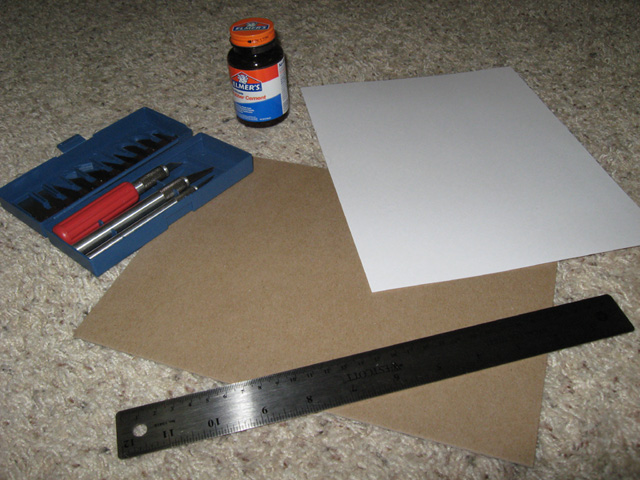
The Graffix chipboard is the star of the show here. I did my homework for a little while and this is the stuff to use. It’s just about as close as I’ve been able to find to the actual material used by WotC in their dungeon tiles. The thickness and stiffness is just about identical. The differences are negligible, and the price is more than right (it’s basically 4 sets for the price of 1 plus a bit for glue/ink/paper replacement as needed).
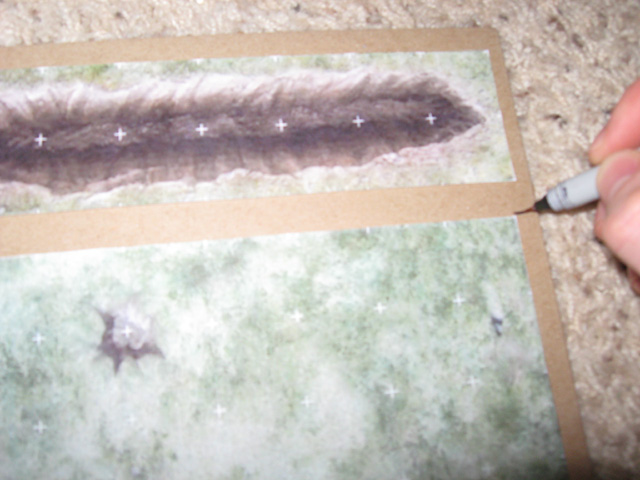
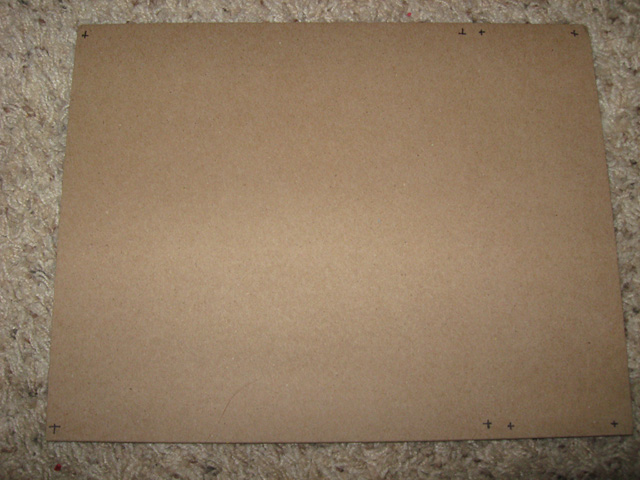
First thing to do is cut out your battlemap and get it pasted onto the chipboard. I make x marks on the chipboard where the corners will be so that I know where to glue.
Once you’re done making the marks, your chipboard will look something like this.
Now you’ll want to take your glue of choice and apply it to both your chipboard and the back of your battlemap. I use rubber cement because it’s what I’ve been using for my character tokens, and thus what I had on hand. The newbiedm suggested spray adhesive, which would probably work just as well. Wax paper makes this process easier. Follow the directions on your glue for best stick.

Stick your battlemap to your chipboard using the marks you made as guidelines. Flatten the edges down well and wait for it to dry a bit.

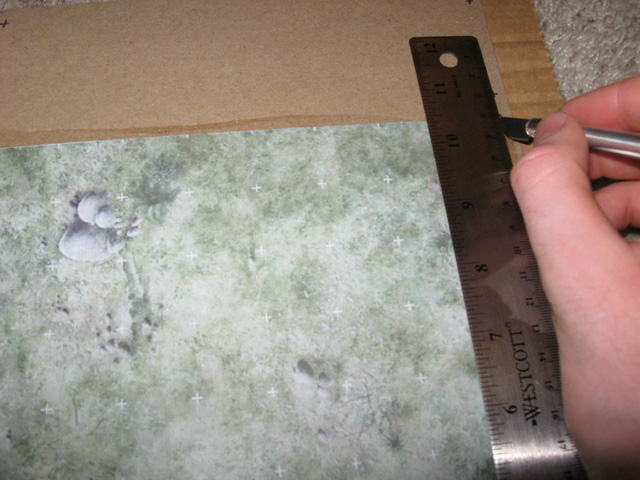
Take the ruler and exacto-knife and cut along the edges. Make sure you’re cutting over something you don’t mind slicing up. I use a doubled-up piece of cardboard, as you can see there beside my hand.
Once you get that piece all cut out, you should be done! Below is a picture of the mat that I photographed the creation of beside a couple custom ones I had already done, and a couple of WotC dungeon tiles.
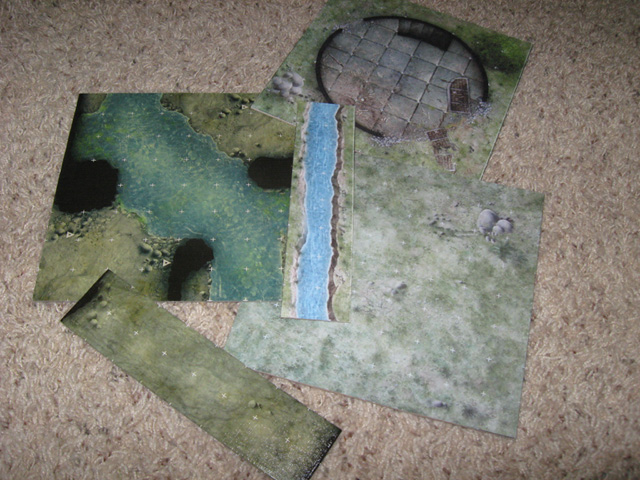
Basically the same process can be used to put a map on the opposite side of the board, except instead of exacto-knifing the board when you’ve glued the map on, you’ll flip the board over and exacto-knife the excess paper hanging over the edges of the chipboard.
The major difference is that the WotC ones are glossier. If you’ve got a nice printer, you can print out pretty decent looking scenery. If you’ve got a normal printer, well, you’ll be a little limited, but, as you can see, the tiles still come out very nicely even with a standard quality printer. I used the “normal” setting. I could see a draft setting still looking decent while saving some ink, and a best setting making some very impressive looking tiles.
Also, here’s how the edges compare:

As you can see, they’re very close, and when you lay them beside eachother and start playing, you really don’t notice the difference much at all. Also, if all else fails and you just keep noticing that 1/32nd of an inch…just remember that you paid 1/4 the amount for a nice looking set of DTs, and you get to customize them!
Thanks for reading, I hope it helps, and thank you to the newbiedm for hosting the blog-post!
————-
And there you have it, my first reader-contributed post. I hope it’s not my last. If you’ve got a topic you’d like to contribute to, or a tutorial you’d enjoy writing, drop me a line at newbiedm@newbiedm.com and let’s get it published! I want to thanks Alex for taking the time to contribute to the blog with his fine tutorial. I’m going to order a pack of that chipboard myself.
———–
Random plot hook of the day: The PC’s arrive at a small city, and the town guard that lets them in makes it a point to mention the nice magical weapon one of them carries. Later that night, a cat burglar breaks into their room at an inn, and makes off with that particular item. Over night, a VIP in town is murdered using the weapon, a lo and behold, the PC’s are wanted for questioning. It seems the bloody blade was left behind after the killing. Now what?


 www. Newbie DM .com
Alex
June 5, 2009
I need to correct myself.
I’ve been ordering books and CDs recently from Amazon and tacked on the standard $2.98 shipping without thinking of the chipboard’s size and weight.
It’ll actually run about $12.00 after shipping, which is still 1/4 of the price of a set of DTs…but only if you go to your local game store and pick it up at MSRP.
Oops!
mike
June 5, 2009
i think its a great idea, but one of the factors about buying tiles for me is its $12, and its hard to find the time to do this when i’m bus with so many other things.
i’m all for DIY d&d, just saying time vs cost has to come in at some point.
newbiedm
June 5, 2009
@Mike: Yeah, but if you can make them custom, and to your design, it’s way cool. I do that now, I take my Dungeon Tiles, scan them into the computer and manipulate them in Photoshop, then print them out on card stock.
For me it’s a great idea because I’m doing something similar anyways, not to save money, but to get designs I really want at my table.
mike
June 5, 2009
absolutely, i agree its great, and for custom jobs for sure. Just being a dad can take up a lot of time. the tutorial is great.
newbiedm
June 5, 2009
@Mike being a dad does take up a lot of time… but for those that can make the time to do DIY dnd, stuff like this is great.
But of course, it is a lot more convinient to drop the 10 bucks at borders for the tiles!
Alex
June 5, 2009
You drop $40 for the amount of tiles you can make with the $12 bucks.
Alex
June 5, 2009
Which is to say, to me, saving $30 far outshines the time-cost. The other thing to consider is that you only have to make what you need for your next session. If you only need 4 tiles and the rest you’re supplementing with WotC tiles that you already have, then you only spend an hour making them. If you have to make 20 tiles, well yes, it’s going to take more time obviously. Aren’t you already taking several hours preparing the game session? What’s finding 2-3 more to make some tiles over a week? Plus, after you’ve made them, you have them until they fall apart.
satyre
June 7, 2009
This looks a cool way to reinforce printable floorplans we’ve been making. I’ve always been a fan of laminating A4 sized floorplans, this looks much more robust. Wonder if you could coat those tiles in some way to prevent damage from spillage?
Kudos to Alex for this tutorial & newbiedm for sharing!
N0Man
August 24, 2009
This is fantastic! I’ve been looking for some ideas on how to make my own custom Dungeon Tiles, especially since since so many of the official ones are limited to certain settings or have out-of-print issues.
I’ve considered using just plain cardboard, plasticard, foamcore, and just a few layers of cardstock, however your suggestion of chipboard (which I wasn’t familiar with) sounds exactly like what I’ve been looking for. Thanks for the great idea!
Colmarr
November 11, 2009
A very handy tutorial. Thanks Alex and thank nDM.
mathmom
January 2, 2010
Clear contact paper would probably work to protect the surface from spills.
jwhalen
March 11, 2010
I have been using Modge Podge to matte my tokens. Works well and makes the tokens resistent to spills and cheeto stains
DIYer
June 7, 2010
For protecting them once they’re printed, I use the same sealer that I use to protect my miniatures. There are several brands available, but I generally use Krylon Matte Finish. There are also high gloss versions if you want the shiny look. You can get it at art stores and even Home Depot for about $4.oo a can. It works great and protects against all those drooling players. 🙂
BTW, thanks for the tutorial. I’ve been trying to figure out which card thickness would be best, and now I know.
nathanpanke
June 30, 2010
This is great I’ve made dozens of tiles based off of this post. Awesome!!! Thanks to both of you.
colawley
August 25, 2010
If you want to really get bulk pricing on the chipboard you can purchase it from ULine for $42 for a case of 960 letter sized pieces.
colawley
August 25, 2010
Sorry website link for ULine: http://www.uline.com/BL_1852/Chipboard-Pads
Thomas D
February 28, 2011
Just stumbled across this post and followed the links to Amazon. For those of you worried about shipping costs, the Grafix chipboard sheets are eligible for free shipping via Amazon Prime.
Scott
April 6, 2011
This is a late addition, however with respect to the thickness difference between the WotC tiles and the DIY tiles, if you make your tiles double-sided, that evens out the thicknesses. I made a double-sided tile last night and it sits flush with the WotC tiles I put around it.
I’d been using Tacky glue for tiles before this, and they would always warp, but the rubber cement works great, and the tiles lay perfectly flat!