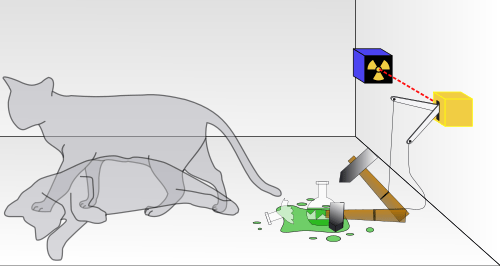
Am I actually blogging again? I guess I am, even though lately I’ve been away from 5e and playing 2e (a blog post for another time). .. I’m blogging because a few recent things have piqued my interest and I HAVE THOUGHTS I felt I wanted to put down on paper, eh, blog paper… whatever. And my thoughts are on audiences, specificlly, the mythical “modern audience” we seem to know a lot about, and perhaps not much of at the same time. There was a Schrödinger’s Cat metaphor there somewhere and I ran with it….
Let’s get to it, because specifically two recent stories have had me thinking about how little companies, and the rest of us, really know about audiences. The first was a video from Mike Mearls about why D&D 4th Edition failed to replace 3.5. The second was EA’s decision to close BioWare, the studio behind Mass Effect and Dragon Age. Almost immediately, people seemed sure they knew who or what to blame. I’m not suggesting the closure is a referendum on The Veilguard or its audience. But the reaction shows how quickly people construct explanations when they think they understand an audience.
That’s where the metaphor comes in… this made me think of Schrödinger’s cat. A cat sits in a sealed box with a mechanism that may or may not kill it, and until someone opens the box, it’s described as both alive and dead. The entertainment industry has its own version: the modern audience. Companies talk about what it wants with great confidence, and critics talk about what it rejects with just as much. But until a product reaches the market, nobody can be sure how large that audience is, what it wants, or how much of its enthusiasm will turn into a purchase.
I’ve been playing D&D since the late 1980s, running games since 4th Edition, and blogging about the hobby since 2009. If those years have taught me anything, it’s that the loudest voice in the room is a poor guide to the rest of it.
What 4th Edition heard
I started DMing with 4th Edition, so Mearls’ video hit close to home. He argues that the biggest problem was that Wizards paid too much attention to the mechanics-focused players dominating online 3.5 discussions, without adequately accounting for the much larger group who approached D&D more casually. The most telling detail comes from the playtests. According to Mearls, a concerning number of testers running martial characters ignored their powers, even at-wills, and just made basic weapon attacks, in a combat system designed around using those powers. The table was telling a different story from the forums.
Mearls’ takeaway is that a successful edition has to work for players who don’t care to learn the mechanics, with more complexity added as it ages to keep experienced players engaged. That’s the whole problem in miniature. Nobody invented those forum conversations. They were real, passionate, and visible. They just weren’t the whole audience.
The fans made a similar mistake. For years, the accepted story was that Pathfinder beat 4e. ICv2’s hobby-channel chart really did rank Pathfinder first in Q2 2011, but a ranking in one sales channel doesn’t prove that Pathfinder outsold D&D across the whole market. People who worked on these games have since disputed that it did. The company misread the audience, and then the audience misread the sales.
Applause isn’t a purchase
Social media can make a perspective look like a market. An idea gets attention, people enthusiastically endorse it, and companies take notice. But a thousand people praising an idea aren’t necessarily a thousand people preordering the book.
People’s positions are also messier than the online argument suggests. Someone might appreciate having more ways to represent themselves in a game without buying every book that offers them. Someone might support greater representation and still prefer the traditional fantasy they’ve enjoyed for decades. Someone might welcome anyone to their table and still dislike the direction of the rules. None of those positions is contradictory.
This distortion runs in both directions, too. The people announcing that a change is what the modern audience demands are visible. So are the people announcing that the same change will kill the game. Neither group gets to speak for the customers who never post about it and simply decide whether to buy the book.
Inclusion Alone Doesn’t Explain the Numbers
That brings me to BioWare, and to the argument I keep seeing: Dragon Age: The Veilguard was what some would describe as “woke,” whatever that means, and the studio paid for it. The game did miss badly. EA said it engaged about 1.5 million players in its launch quarter, nearly 50% below expectations. That’s an engagement figure, not a sales number.
But Baldur’s Gate 3 is also a big fantasy RPG that’s widely seen as inclusive, and Larian’s CEO says it has sold more than 20 million copies. Wizards of the Coast also called the 2024 Player’s Handbook, with its shift from “race” to “species,” the fastest-selling D&D product in the game’s history. If inclusion alone decided these outcomes, they shouldn’t look so different. These aren’t directly comparable sales figures, and I’m not suggesting they are. But they illustrate why it’s difficult to attribute commercial success or failure to a single creative philosophy. Inclusion and commercial success are separate questions. Sometimes they go together, but one doesn’t automatically deliver the other.
My critique of The Veilguard
I’ll tell you where I land, with one big caveat: I never played The Veilguard. Everything I know about it comes from clips, articles, and both sides of the argument on social media. That’s exactly the kind of signal this essay warns about, so weigh my opinion accordingly. From what I’ve seen, I don’t think its representation was well done.
Compare it with Dragon Age: Inquisition. When Iron Bull explains that Krem would be called an Aqun-Athlok in Qunari society, the idea comes from the world itself. It has a word, a culture, and a place in Thedas. To me, that’s effective worldbuilding: the representation grows out of the setting’s culture and history instead of feeling imported from outside it. The Veilguard puts modern terms like “non-binary” into that same world. That comes across to me as heavy-handed and out of universe. The game does acknowledge the Qunari term, but from what I’ve seen, the modern word still seems to break the world. That’s a complaint about craft, not about whether these characters belong in fantasy. Inquisition had a transgender character too, and a former BioWare producer says it sold more than 12 million copies. Not everyone agrees with me, either. GLAAD considers Taash’s use of the word “nonbinary” an important achievement, and those players’ reactions are as real as mine.
I also can’t tell you that this cost EA a single sale. The Veilguard spent years in development and began as a live-service game, and EA’s closure letter talks about focusing on larger opportunities, not about Taash. My opinion of the writing is just that: an opinion. It isn’t a sales analysis, and neither is anyone else’s.
When the audience finally reached for its wallet
The closest thing we’ve had to a pure wallet vote came in January 2023, when a leaked Open Game License revision sent the community into revolt. Fans organized to cancel their D&D Beyond subscriptions, and some reports put the losses at 40,000. Wizards completely reversed course in a little over three weeks.
It looks like a tidy victory for the wallet, but the people inside tell a more complicated story. Hasbro’s CEO called the cancellations comparatively minor in the context of the business. D&D’s executive producer said Wizards was already reworking the document before the cancellations began, and that a company its size couldn’t have changed course that quickly.
Those claims aren’t contradictory. One is about financial impact, and the other is about timing. Companies also have reasons to downplay this kind of pressure, and we can’t verify their account from the outside. Either way, the community that revolted in 2023 was still part of the broader market that made the 2024 Handbook a record-setter less than two years later. Audiences can be furious and still come back. That’s another reason to be careful about what you read into the noise.
Opening the box doesn’t tell you why
I used to think sales would settle these arguments. Now I think they only settle the easiest question: did it sell? They can’t tell you why. A book can succeed or fail because of its art, price, marketing, or place in an edition cycle. Good luck isolating how much a single design philosophy contributed.
D&D makes this even harder because one person’s purchase can serve a whole table. The DM buys the books, and four or five players may show up with nothing but dice. Those players are part of the audience, and some of them will eventually run their own games. An inclusive choice that makes a new player feel welcome might not appear on a sales chart for years.
Every DM already knows how poorly we predict our audiences. You spend hours prepping a dungeon, and the players would rather spend the session buying gear in Waterdeep. The solution isn’t to stop preparing. It’s to put something on the table, watch what actually happens, and stay honest about what you learned.
So, where’s the cat?
Maybe the modern audience isn’t one audience at all. Maybe it’s several overlapping groups. Some want new approaches to fantasy, some want the familiar, and many want both depending on the day. Companies have every reason to chase those people. They can also make choices simply because they believe those choices are right. I want them to. Make the game welcoming. Experiment. Take creative risks. Just be honest about which kind of decision you’re making.
“We believe this makes the game better” is a conviction. You can stand behind it even if it costs you some customers. “This is what the audience demands” is a market prediction, and predictions can be wrong. The trouble starts when a company dresses up one as the other. It’s just as much of a mistake when critics claim that a book’s failure, or success, proves their politics right.
The audience will eventually vote with its wallet. But when you finally open the box, all you’ll know for certain is whether the cat is alive. You’ll still have to figure out why.


Dave Clark
November 2, 2026
Welcome back to blogging! Even if for this solo piece.
I think it’s really hard for smaller creators and loud solo voices to understand how wide the RPG hobby is – once an audience grows to a certain scale only professionals can understand it
newbiedm
November 2, 2026
Hi Dave. I’m still around, the blog is just dormant because I feel I don;t have much to say or I just waste my thoughts spewing them out on twiter instead. But I’m still around!